You can learn hypnosis.
The better question is what to learn first so you actually practice instead of endlessly collecting information.
A lot of beginners watch dozens of inductions, save pages of scripts, and learn the names of a hundred different effects. Then somebody asks if they want to try something simple, and they still have no idea where to begin.
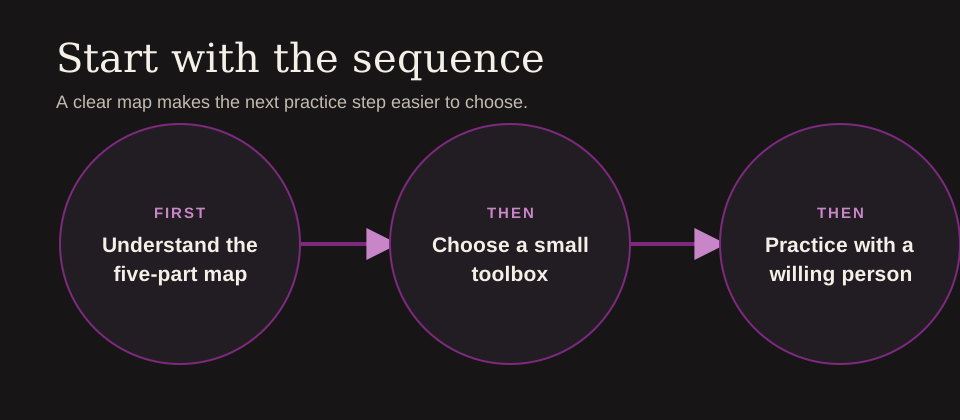
You do not learn hypnosis by collecting the most techniques. You learn it by understanding the map, choosing a small toolbox, practicing one piece at a time, and paying attention to what happens.
Learn the map before collecting techniques
Before you worry about which induction looks the coolest, understand the structure of a complete interaction.
In Hypnotist Secrets, that structure has five parts:
- Pre-talk
- Induction
- Deepener
- Suggestions
- Exit
Each part has a job. The pre-talk creates a clear, willing setup. The induction guides attention into the exercise. The deepener continues that focus. Suggestions create the experience you both agreed to explore. The exit brings the exercise to a close clearly.
That map matters because a technique is much easier to learn when you understand where it fits. You are not just memorizing words. You are learning what those words are trying to do.
The free Five-Part Hypnotic Framework training walks through each part one at a time.
Build a tiny toolbox
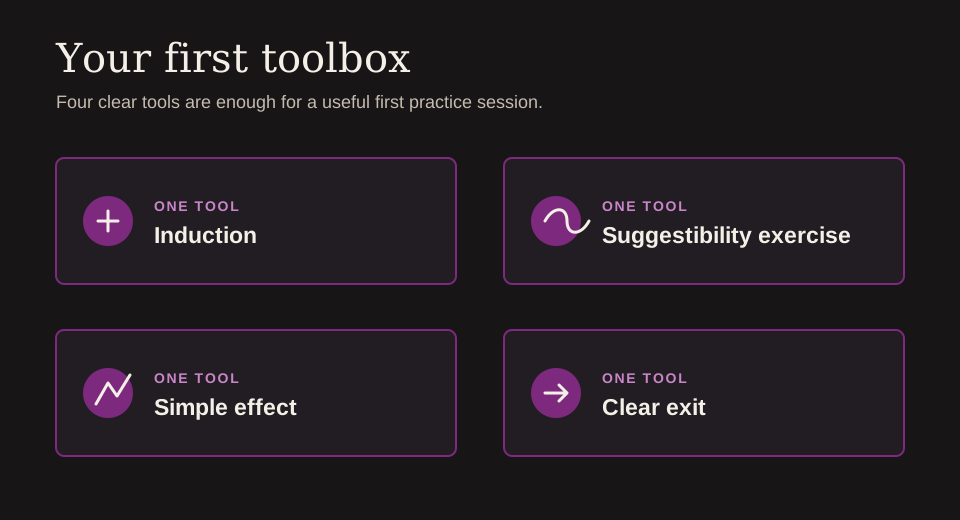
Once you understand the sequence, start with a few small tools. Not twenty.
Pick one induction you can practice. Pick one simple suggestibility exercise. Pick one simple effect. Pick one clear way to bring the person back out of the exercise.
That is enough to start.
The point of a toolbox is not to carry everything you have ever seen online. It is to have a few small mini-scripts that feel natural enough to use when it is time to practice.
When you learn too many things at once, it gets confusing fast. You start trying to remember what comes next instead of paying attention to the person in front of you.
Start with one from each category. Practice those until they feel comfortable. Then you can add or swap tools as you learn more.
What learning hypnosis actually looks like
Learning hypnosis does not mean waiting until you feel completely ready and then trying to lead a perfect session.
It looks more like this:
You explain a short exercise to somebody who wants to try it. You guide one simple experience. You notice their response. Then you ask what they noticed.
Maybe you try a magnetic-fingers exercise. Their fingers move a little, but they say they were not sure where to focus. That gives you something useful for next time. You may slow down, make the instructions simpler, or give them one clearer image to work with.
That is practice.
You do not need a huge reaction to learn something. A small response, an unexpected response, or even a moment of confusion can tell you what to adjust next.
Do not wait for perfect confidence
It is normal to feel awkward when you are new. You are learning how to speak clearly, guide attention, notice feedback, and stay present at the same time.
A short mini-script can help at first. Practice it out loud until you are not fighting to remember every word.
But do not confuse a script with the skill itself. The skill is understanding the purpose behind the words and learning to adjust them for the person in front of you.
That is why understanding hypnosis matters more than collecting scripts.
Practice with somebody willing
Choose somebody who wants to participate. Explain what you are practicing and make it clear that they can stop, move, speak, or ask a question whenever they want.
You are not doing hypnosis to somebody. You are guiding a willing person through an experience they agreed to have with you.
The more honest and clear the setup is, the easier it is for both of you to focus on the exercise instead of wondering what is supposed to happen.
Do not make the first attempt bigger than it needs to be
A beginner mistake is trying to turn a first practice session into something huge.
You do not need to prove you can create a dramatic reaction. You do not need to handle somebody’s trauma, mental-health condition, medical concern, or serious personal problem. Keep early practice educational, small, and appropriate.
The goal is to learn how to guide one clear experience responsibly.
If you want a few common ways beginners make early practice harder than it needs to be, read 7 Beginner Hypnosis Mistakes.
How you know you are making progress
Progress is not only measured by how dramatic an exercise looks.
You are improving when your explanations get clearer. When you know what part of the interaction comes next. When you can stay calm if somebody responds differently than you expected. When you start noticing which suggestions help and which ones are just extra words.
That is how a small toolbox becomes natural.
Learn the map. Choose a few tools. Practice with willing people. Use the feedback. Then make the next attempt a little better.