
Most myths about hypnosis come from watching the most dramatic version of it.
A person closes their eyes, their head drops, the hypnotist says "sleep," and suddenly it looks like they are gone.
They are not.
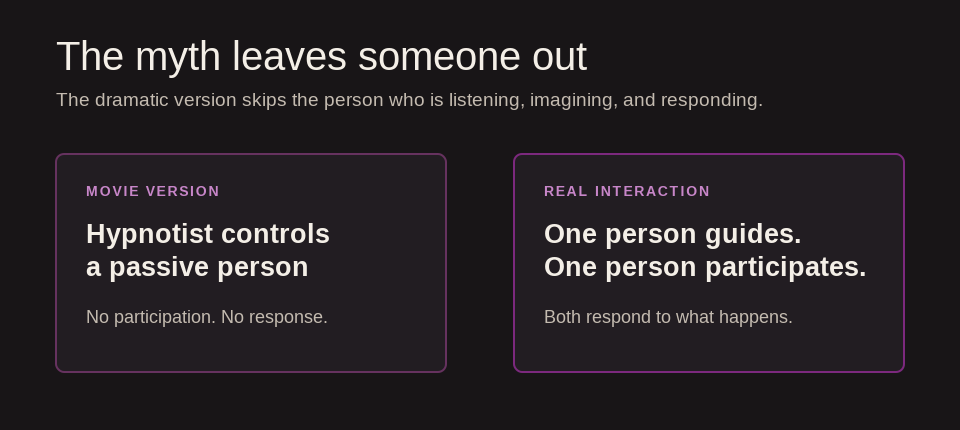
Hypnosis makes more sense when you see it as a cooperative experience. One person is guiding attention and making suggestions. The other person is listening, imagining, responding, and letting you know what is actually happening.
That does not make it boring. It makes it something you can understand.
1. "Hypnosis is mind control."
A hypnotist can guide attention, make suggestions, and create momentum in an interaction.
That is not the same thing as taking over somebody's mind.
The person is still there. They can hear you. They can speak, move, stop, or choose not to go along with an exercise.
That said, hypnosis can be used unethically.
An unethical hypnotist can exploit somebody's willingness to go along, social pressure, authority, and the momentum of a public interaction. That is not mind control. It is more like advanced bullying.
Someone can still agree to something or go along with a request they later regret. That does not mean they had no agency or that the hypnotist had magical power. It means the situation was manipulative.
That is why consent has to be specific. Agreeing to try an exercise is not permission to be pressured into something outside of that exercise.
2. "If someone says 'sleep,' you become unconscious."
In hypnosis, "sleep" is often used as a cue.
It may mean close your eyes, relax, or settle into the exercise. It does not mean the person has become unconscious in the ordinary sense.
If they were actually asleep, they would not be listening to the suggestions or responding to what is happening.
People can be very relaxed and still aware. They might hear everything. They might remember everything. They might feel calm, focused, distracted, curious, or surprised.
There is no single feeling that proves hypnosis happened.
3. "You need a special voice, a swinging watch, or some kind of power."
Those are symbols people recognize from movies and stage performances.
They are not the skill.
A clear instruction is more useful than a dramatic voice. A person who feels comfortable, understands the exercise, and has something specific to focus on is in a much better position than somebody listening to a mysterious performance.
You do not need to look like a hypnotist from a movie. You need to communicate clearly and pay attention.
4. "Everyone responds the same way."
They do not.
One person may easily picture something in their mind. Another may respond more to physical sensations. One person may find an ocean calming. Somebody else may connect it with stress.
That is why a script can get you in trouble. It assumes the same words, images, and timing will make sense for everybody.
A better question is, "What are you noticing?"
Their answer gives you something real to work with.
5. "It either works perfectly or it fails."
This is one of the most discouraging beliefs a beginner can carry.
If somebody's fingers move a little instead of dramatically snapping together, that does not mean nothing happened. It means you have a small response to work with.
If they say they were distracted, you can make the next instruction simpler. If an image does not land, you can ask what would make more sense for them.
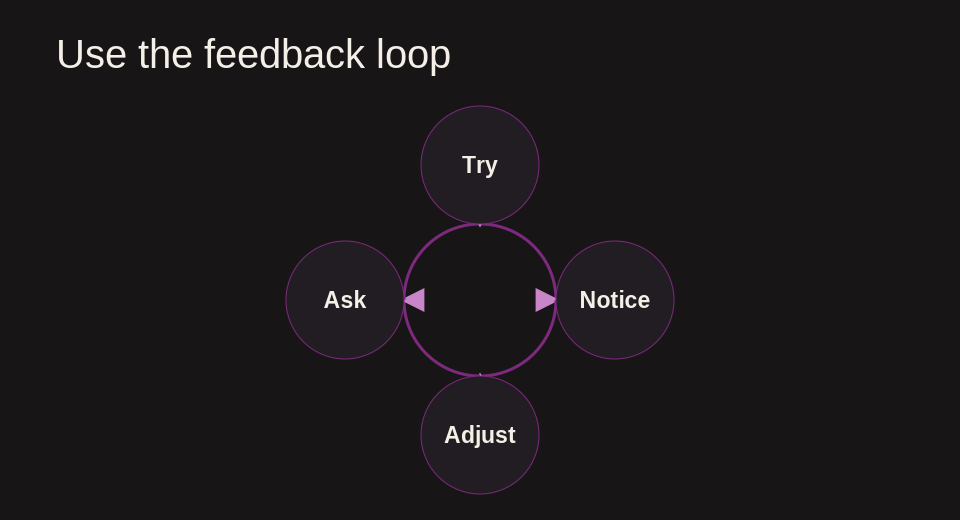
A real interaction has feedback. You try something, notice the response, ask about their experience, and adjust.
That is how you learn instead of panicking when the first attempt does not look like a video clip.
6. "You need lots of techniques before you can practice."
Usually, too many techniques make a beginner worse.
You start second-guessing yourself. You try to remember ten different inductions. You feel like you have to pull out something new every time.
Keep your first toolbox small.
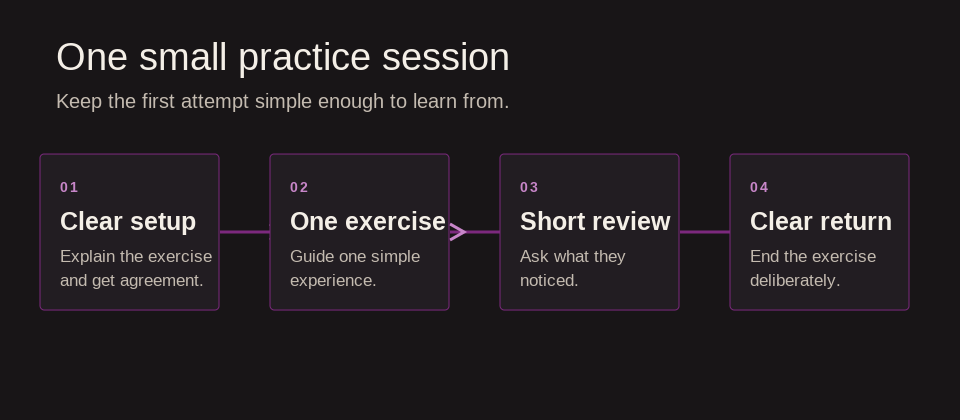
Pick one simple way to direct focus, one exercise you understand, and one clear way to end the exercise. Practice those until they feel natural. Add more later when you have a reason to add more.
7. "Scripts are the skill."
Scripts can give you words to start with. They are not the art of hypnosis.
If you rely on a script and the person does not react the way the script says they should, it is easy to freeze. Then you may think hypnosis does not work, when the real problem is that the script did not fit the person in front of you.
No script will work perfectly on every subject.
The useful skill is paying attention to reactions and experiences, then adapting in real time. That is what makes hypnosis feel intuitive instead of mechanical.
Read how hypnosis works for the focus-and-imagination model behind a basic exercise, or why understanding beats scripts when the response is different than you expected.
What actually matters
You do not need to be mysterious. You do not need to force a dramatic reaction. You do not need to memorize twenty techniques.
You need a willing person, a clear exercise, and enough attention to notice what happens next.
That is a much better place to start than the myths.