Hypnosis is not mind control. It is not black magic. And despite what hypnotists say when they use the word “sleep,” it is not actually sleep either.
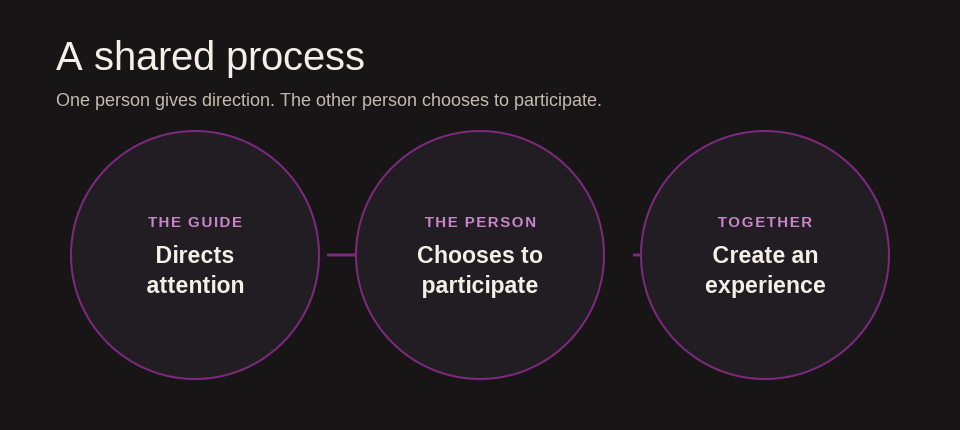
Hypnosis is a willing person using focus and imagination to have an experience, while somebody guides them through it.
That is the simple version.
The person being hypnotized is not gone. They are not unconscious. They can hear you, talk to you, move, stop, or decide they do not want to keep going.
So if you have ever wondered, “Can someone really make me do something I do not want to do?” the answer is no.
Hypnosis works best when both people are on the same page about what they are doing and where they are trying to go.
Hypnosis is cooperation, not control
The easiest way to think about hypnosis is the pilot-and-copilot example.
The hypnotist is the pilot. The person being hypnotized is the copilot.
The pilot can guide the plane. They can point it in a direction. But both people have to agree on the destination.
If you are trying to guide somebody toward an experience they do not want to have, they are not just going to sit there with no control while you force it to happen. They can stop participating. They can speak up. They can open their eyes. They can say no.
That is why a pre-talk matters.
Before you try anything, explain what you are practicing. Tell them what may happen. Make sure they want to try it. Let them know they can move, talk, stop, or ask a question whenever they want.
That is not a boring part before the hypnosis starts.
That is the beginning of hypnosis. You are both getting on the same page.
Hypnosis can still be used unethically
That does not mean hypnosis cannot be used in an unethical way.
An unethical hypnotist can exploit somebody’s willingness to go along, social pressure, authority, and the momentum of a public interaction. That is not mind control. It is more like advanced bullying.
Someone can still hand over something, agree to something, or go along with a request they later regret. The fact that they did it does not mean they had no agency or that the hypnotist had magical power. It means the situation was manipulative.
That is why consent has to be specific. Agreeing to try an exercise is not permission to be humiliated, pressured, or pushed into doing something outside of that exercise.
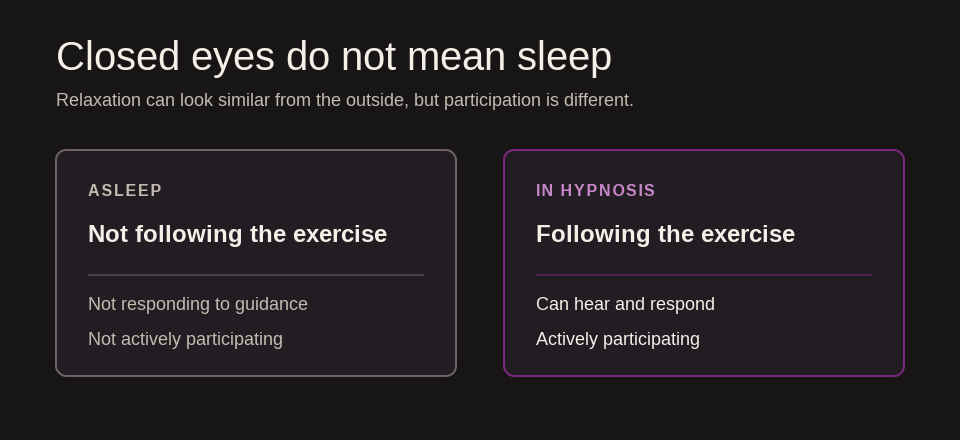
Are people asleep during hypnosis?
No.
They may have their eyes closed. Their head may drop. They may look deeply relaxed from the outside. But they can still hear you and participate in what is happening.
If somebody was actually asleep, giving them suggestions would be pointless. They would not be following the exercise with you.
The word “sleep” can confuse people because it sounds like somebody is being knocked out.
That is not what is happening.
In hypnosis, the person may feel relaxed, focused, absorbed, or like they are paying more attention to the experience than to everything else around them. But they are still there.
What is actually happening?
At its simplest, hypnosis uses a few things working together:
Focus.
Imagination.
Participation.
You guide somebody’s attention to one thing. Maybe it is the space between their fingers. Maybe it is the feeling of their eyelids. Maybe it is their breathing or a point in front of them.
Then you give their imagination something to work with.
You might ask them to imagine magnets gently pulling their fingers together. You might ask them to notice their eyelids getting heavier. You might ask them to picture a place that feels calm to them.
Then you pay attention to what happens.
Maybe their fingers move. Maybe they say their eyes feel heavy. Maybe they are not sure what they are supposed to notice yet.
That response matters.
You do not just keep talking at them because the script says to. You use what they are experiencing to decide what makes sense next.
Every response to a suggestion is feedback that can be used to make the experience more effective.
What hypnosis can feel like
There is not one feeling that proves somebody is hypnotized.
Some people feel very relaxed. Some feel focused. Some feel like their body is responding before they expected it to. Some feel completely normal, but notice a small change when they actually pay attention.
For example, somebody may say, “I knew I could move my fingers, but they still felt like they wanted to come together.”
That is still something to work with.
You do not need somebody to collapse into a chair or forget who they are for hypnosis to be real. A small, honest response gives you something more useful than a dramatic reaction you are trying to force.
The more you understand what the person is noticing, the better you can guide the next part of the experience.
What hypnosis is not
It is not something you do to an unwilling person.
It is not a test of whether somebody is weak-minded or easy to control.
It is not about making somebody perform for you.
And it is not about saying a magic word perfectly.
Hypnosis is a structured interaction between two people. One person guides attention and imagination. The other person participates, notices what happens, and gives you something to work with.
That is why the whole interaction matters more than one technique.
What not to overthink
You do not need to know whether somebody is “deep enough.”
You do not need to decide whether a small response counts.
You do not need to look for one exact feeling that means hypnosis happened.
Start with a person who wants to participate. Explain one simple exercise. Give them something clear to focus on. Ask what they noticed. Then use that response.
That is a real place to start.
If you want to see how that fits into a complete interaction, the free Five-Part Hypnotic Framework training walks through pre-talk, induction, deepening, suggestions, and exit one step at a time.
Hypnosis is not about taking control away from somebody.
It is about guiding a willing person through an experience they are actively helping create.