
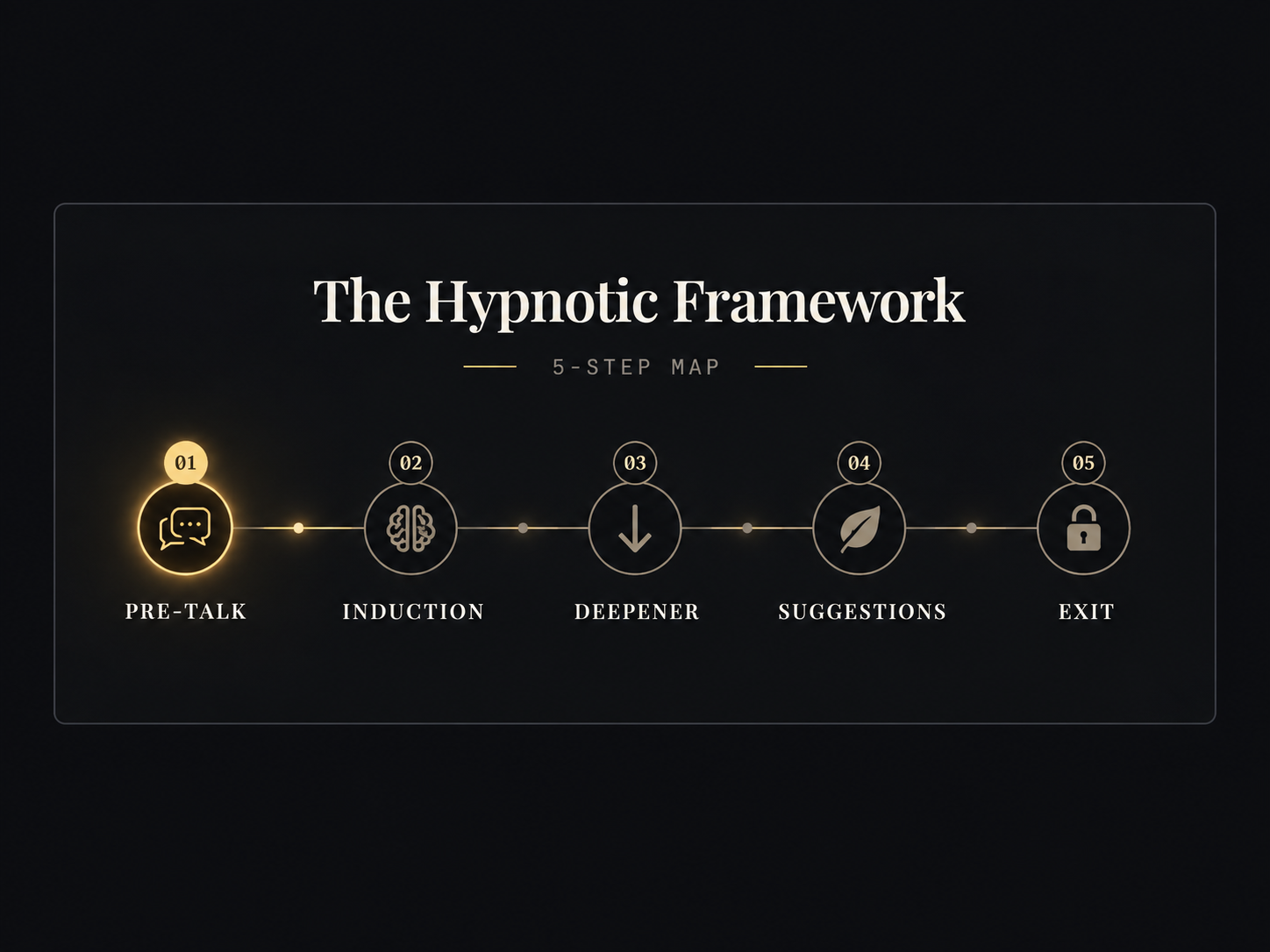
A well-structured session is easier for everyone. The subject knows what to expect; the beginner knows what to do next. Here is the practical framework used in Hypnotist Secrets. If you want the lesson version, you can get the full Hypnotic Framework training free here.
1. Pre-talk
Explain the exercise, what the person may notice, and what it is for. Keep it honest. This is the shared setup for a voluntary experience.
2. Induction
Guide attention into the exercise. It can use progressive relaxation, eye closure, or another simple method. The technique matters less than its purpose: focused participation.
3. Deepener
Invite the person to settle further into the focused state. A countdown, slower language, or repeated suggestion can be a natural continuation.
4. Suggestions
Use direct or indirect suggestions aligned with the purpose you discussed. Direct suggestions are straightforward; indirect suggestions can use stories or imagery. Adapt to the person.
5. Exit
Tell the person the exercise is ending and bring them back to alertness clearly. The exit completes the arc begun in the pre-talk. If you are still wondering whether someone is “asleep,” read what hypnosis really is.
What a hypnosis session actually feels like
A complete hypnosis session has five parts. But knowing the names of the steps is not the same as knowing what it feels like to lead somebody through them.
You are guiding - not doing hypnosis to somebody
Think of it like a pilot and copilot. You are the pilot, and your subject is the copilot. You can guide the plane, but both of you have to agree on the destination. If you want to take them somewhere they do not want to go, they are not going to follow you there.
That is why the pre-talk is not filler. Tell them what is about to happen, make sure they know they can move, speak, stop, or ask a question, and get clear on what they want from the experience. If you both agree on the destination, hypnosis gets much easier.
A real session is not one long script
New hypnotists often think they need the perfect words, delivered perfectly, from beginning to end. That is not how a real session works. You give a suggestion, notice what happens, and use what happens.
Maybe you suggest their hand is getting lighter. It might move a little. They might laugh because it feels strange. They might not notice much yet. None of that means you failed. If the response is different than you expected, use it to your advantage. Make the next suggestion easier, build on a small response, or change direction.
Keep your first sessions simple
You do not need twenty inductions, ten suggestibility tests, and a huge library of metaphors before you practice. Who wants that? It just makes getting started harder.
Pick one simple induction, one deepener, one effect, and one way to bring them back out. Practice that until it feels natural. You can build your toolbox later.
Pay attention to their associations
Do not blindly use the same visualization on everybody. An ocean might feel calm and peaceful to one person. To somebody else, it might bring up stress. If you want them to feel calm, ask what place makes them feel calm, then use that.
You are not trying to figure out every detail of their life before you hypnotize them. You are just paying attention. The more you notice what works for your unique subject, the better you get at guiding the next part of the experience.
Do not chase a dramatic reaction
They do not need to be slumped over in a chair for hypnosis to be working. A small, real response is enough to learn from. Your job is not to force a huge moment. Your job is to lead a willing person through a clear, safe experience - one step at a time.
That is what the framework gives you: a map, a smaller toolbox, and a real place to start.