Most people do not mess up hypnosis because they are incapable of learning it.
They mess it up because they get in their own head.
They watch a bunch of videos. They try to remember every word of a script. Then somebody actually agrees to try something with them, and all of a sudden they are wondering what to say first, what comes next, whether it is working, and whether they are doing it right.
You do not need to have everything figured out before you practice.
You need to understand the basic structure, have a few things you are comfortable trying, and pay attention to the person in front of you.
Here are the mistakes that make getting started harder than it needs to be.
1. Skipping the pre-talk because you want to get to the good part
A lot of beginners want to jump straight into an induction.
But if the person does not know what you are doing, what you are practicing, or what they are supposed to do, they are going to be thinking about all of that instead of participating in the exercise.
Just tell them what is about to happen.
Tell them what you are practicing. Let them know they can move, talk, stop, or ask a question whenever they want. Make sure they actually want to try it.
That is the pre-talk.
It is not some long speech you have to memorize. It is you and the other person getting on the same page before you start.
The free Five-Part Hypnotic Framework training shows where that fits into the full interaction: pre-talk, induction, deepening, suggestions, and exit.
2. Trying to get a huge reaction right away
You do not need somebody falling over, forgetting their name, or having some crazy reaction for a practice attempt to be useful.
Honestly, chasing that stuff is where people start making it weird.
You start talking too fast. You add a bunch of extra words. You stop noticing whether the person is following you because you are waiting for the big moment.
Instead, pay attention to what is actually happening.
Maybe their fingers move a little. Maybe they say their eyelids feel heavier. Maybe they laugh because the exercise feels strange. Maybe they do not notice much yet.
Good. Ask them about it.
You are not trying to put on a show. You are learning how to guide somebody through an experience they agreed to have with you.
3. Trying to learn twenty things before trying one thing
This one will keep you stuck forever if you let it.
You do not need twenty inductions. You do not need every suggestibility test you have seen online. You do not need a giant folder full of scripts before you try anything.
Who wants that?
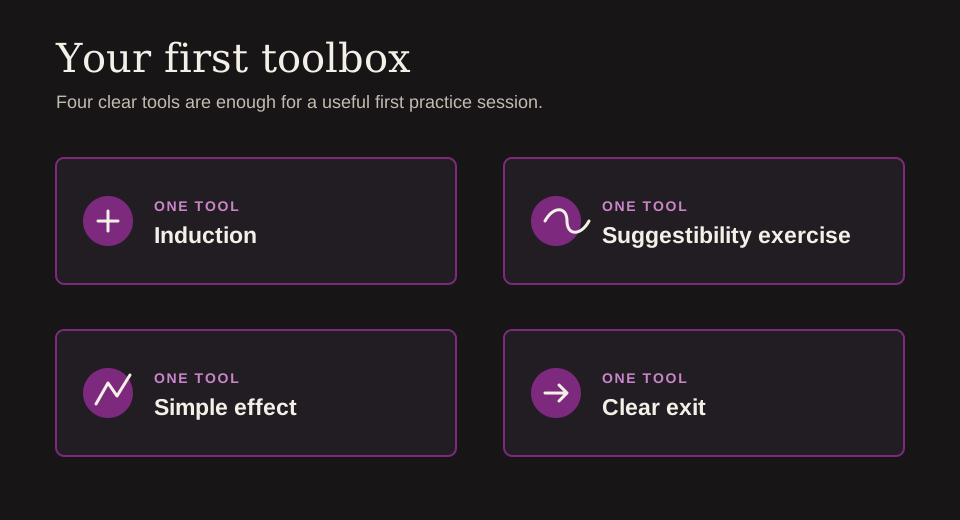
Pick one induction. Pick one simple suggestibility exercise. Pick one simple effect. Pick one way to bring them back out of the exercise.
That is your first toolbox.
The whole point is to have a few mini-scripts in your head that you can actually use without trying to remember what comes next every five seconds.
Practice those until they feel comfortable. Then add more things later if you want.
4. Reading a script and ignoring the person
Scripts can help when you are new. They give you a place to start, and they make it easier to practice saying the words out loud.
But you cannot just read words at somebody and pretend every person is going to respond to them the same way.
Say you use an ocean visualization because it sounds relaxing to you. For one person, that might be perfect. For somebody else, the ocean might make them think of stress, deep water, or something they do not like at all.
So ask.
If you want somebody to imagine a calm place, ask them what place makes them feel calm. Then use that.
You do not need to overcomplicate it. You are just paying attention to what works for the person you are with.
That is why understanding the purpose behind a script matters more than collecting more scripts.
5. Thinking a small response means it did not work
A beginner will give a suggestion, see a small response, and immediately decide it failed.
That is not how you should look at it.
Let’s say you try magnetic fingers. Their fingers move a little, but afterward they tell you they were not really sure what they were supposed to focus on.
Perfect. You learned something.
Next time, slow down. Give them one clearer image. Make the instructions simpler. See what changes.
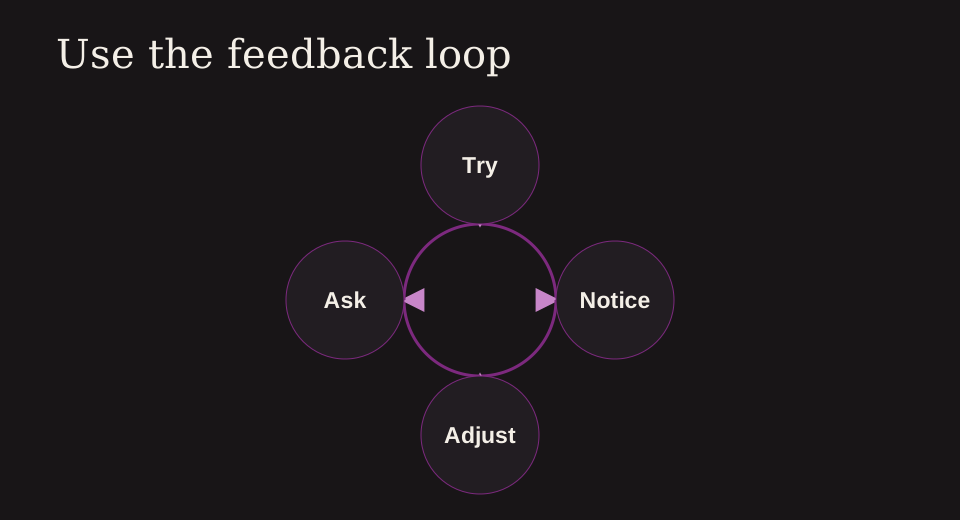
Every response to a suggestion is feedback that can be used to make the experience more effective.
A small response is still a response. Confusion is feedback too. Even no obvious response can tell you to change something instead of just repeating the same words louder.
6. Making your suggestions too vague
“Relax more” is not very helpful if the person has no idea what they are supposed to do with that.
Give them something specific to notice.
You might have them notice the weight of their eyelids, the feeling of their feet against the floor, or the way their breathing changes as they focus on one thing.
You are not trying to make every suggestion complicated. Usually the opposite is better.
Give their attention somewhere clear to go.
7. Forgetting to end the exercise
An exit does not need to be dramatic either.
Just let the person know the exercise is ending. Bring them back clearly. Give them a second to open their eyes, stretch, move around, and tell you what they noticed.
That is it.
But do not skip it.
A clear exit makes the whole interaction feel complete. It also gives you a natural moment to ask what worked, what felt different, and what you would adjust if you tried it again.
For the full session sequence, read What Happens in a Hypnosis Session? The Five-Part Structure.
What not to overthink on your first attempt
Your first practice attempt should not be a huge hypnosis session.
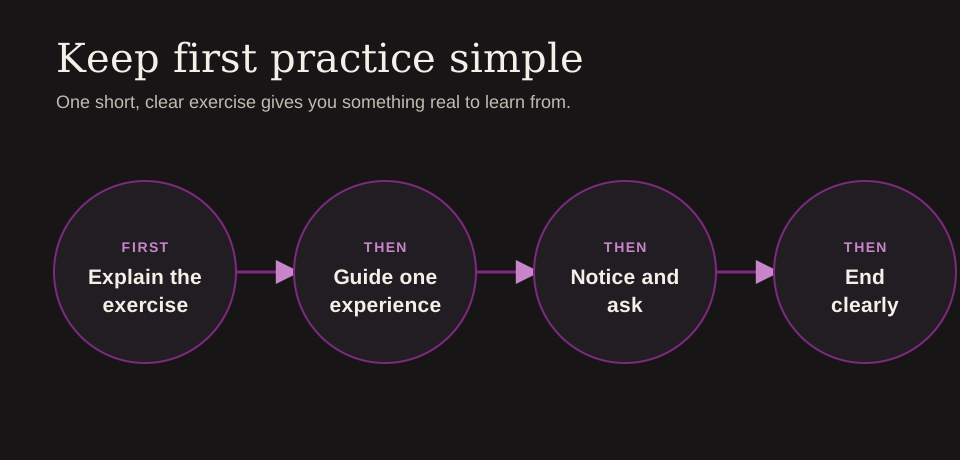
Find somebody who wants to participate. Explain one short exercise. Guide it. Ask what they noticed. End it clearly.
You do not need to prove anything.
You also do not need to try to handle somebody’s trauma, mental-health condition, medical concern, or serious personal problem. Keep your early practice small, educational, and appropriate.
The goal is to get experience guiding attention, using clear words, noticing responses, and adjusting.
That is where confidence actually comes from.
Start with a clear setup. Keep your toolbox small. Listen to the response. Try again.