
Hypnosis does not work because somebody finds a magic sentence.
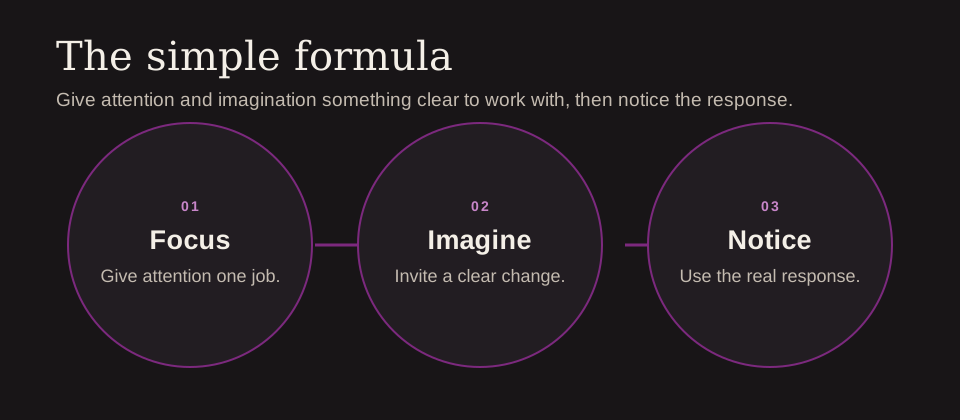
It works when a willing person focuses on something, uses their imagination, and responds to the experience while you pay attention to what is happening.
That is the basic idea. Give them something clear to focus on. Invite them to imagine something changing. Then notice their response and decide what makes sense next.
That is a lot more useful than trying to memorize the perfect induction.
The basic formula: focus, imagination, and response
Most hypnosis techniques look different on the surface. One person may use a hand exercise. Another may use eye closure, a countdown, or a visualization.
Underneath, the useful parts are usually the same.
- Give the person one thing to focus on.
- Invite their imagination to do something with that focus.
- Notice what actually happens.
A small movement. A change in their breathing. A laugh. A look of surprise. Even an answer like, "I do not really feel anything yet."
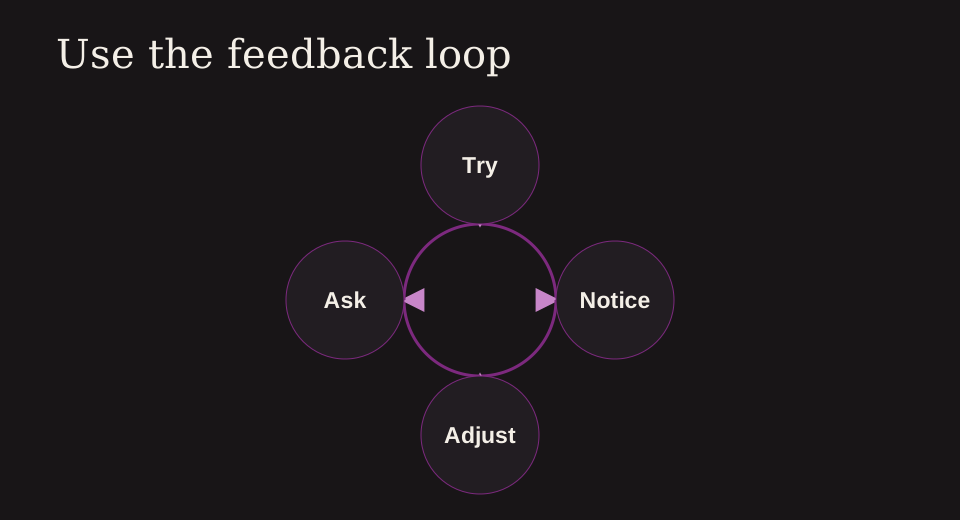
Every response to a suggestion is feedback that can be used to make the experience more effective.
What this looks like in a real exercise
Imagine you are doing a simple magnetic-fingers exercise.
You ask someone to hold their hands out and focus on the gap between their index fingers. Then you invite them to imagine there are magnets on the tips of those fingers, gently pulling closer together.
You are not trying to force their hands to move. You are giving their attention and imagination something specific to work with.
Maybe their fingers move a little. That is useful. You can slow down, point out the small movement, and build on it. You do not need to jump to a bigger effect just because you expected one.
Maybe nothing obvious happens. That is useful too. You can ask what they noticed, make the instruction simpler, or choose a different exercise. The goal is not to prove that hypnosis "worked" in one dramatic moment. The goal is to learn how this person responds.
Attention gives the experience somewhere to start
The object of focus does not have magical power.
A spot on the wall is just a spot on the wall. A hand is just a hand. The value is that it gives the conscious mind one clear job instead of letting it bounce around and wonder what it is supposed to be doing.
That is why simple instructions are usually better than complicated ones.
"Focus on the space between your fingers."
"Notice the weight of your eyelids."
"Pay attention to your breathing for a moment."
Give them something clear. Let them actually do it.
Imagination turns words into something personal
When you say, "Imagine your eyelids becoming heavy," you are not demanding that a person perform for you.
You are inviting them to take part in the experience.
This matters because people do not all imagine things in the same way. An ocean might feel calm to one person and stressful to somebody else. If you want to use a calming visualization, it makes more sense to ask what place feels calm to them than to blindly use your favorite script.
The words are not the point. What the words help the person imagine is the point.
That is why hypnosis gets better when you pay attention to the individual in front of you.
Why the pre-talk matters before anything starts
Before an exercise, tell the person what you are about to do and what they may notice.
Keep it simple. Keep it honest. Make sure they are willing to take part.
The pre-talk is not filler before the "real" hypnosis begins. It gives both of you the same map.
If someone is worried that they are going to lose control, they are busy worrying instead of participating. If they think they are supposed to be unconscious, they may mistake normal awareness for failure.
A clear explanation removes some of that confusion.
They can still hear you. They can still speak. They can still stop. You are guiding an experience with them, not doing something to them.
What not to overthink
Do not wait for a dramatic movie moment before you count something as useful.
You do not need a deep voice. You do not need a giant toolbox. You do not need one perfect script that works on everybody.
Start with one simple exercise. Give a clear instruction. Notice the response. Ask about their experience. Adjust from there.
That is how you stop guessing and start learning.
If you want to see how this fits into a complete interaction, read what happens in a hypnosis session. You can also learn why understanding beats scripts when the response is different than you expected.
The takeaway
Hypnosis works best when it is treated like a shared process, not a performance.
Focus attention. Use imagination. Notice what happens. Adjust to the person in front of you.
That is the foundation.