
Practice is where hypnosis stops being interesting information and starts becoming a skill. It is also where a lot of beginners freeze.
They think the first attempt has to sound smooth, create a huge reaction, and go exactly like the video they watched. It does not.
Your first practice session is one small, cooperative experiment. You guide something simple, notice what happens, ask about it, and make the next attempt a little better.
If you want to see the whole sequence before you try it, the free Five-Part Hypnotic Framework training walks through the pre-talk, induction, deepener, suggestions, and exit one piece at a time.
Start with somebody who actually wants to participate
Find somebody who is curious and willing to try a short exercise with you. Tell them what you are practicing, what they may notice, and that they can move, speak, stop, or ask a question whenever they want.
You are not trying to “get” somebody into hypnosis. You are guiding a person through an experience they agreed to have with you.
Think of it like practicing a conversation, not performing a trick on somebody. The better you both understand what you are doing, the easier it is to pay attention to what is actually happening.
Build a tiny first-practice session
You do not need twenty inductions, ten suggestibility tests, and a giant folder of scripts before you practice. Who wants that? It just gives you more things to overthink.
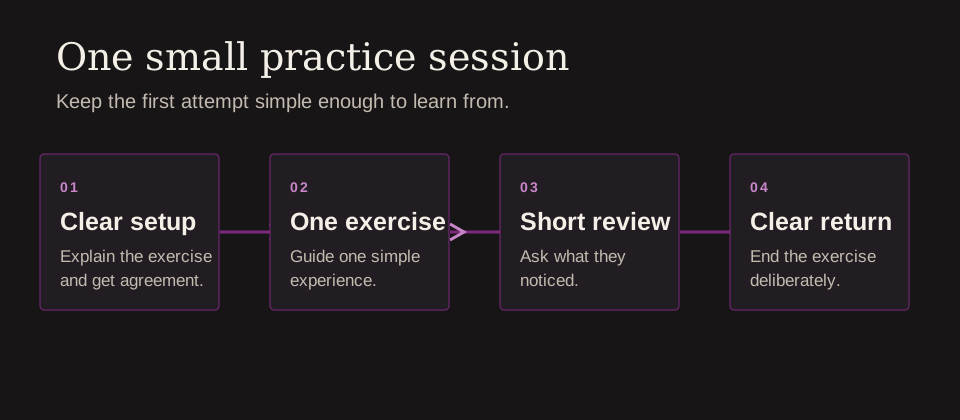
Start with four simple pieces:
- A clear setup - Explain the exercise and make sure the person is comfortable participating.
- One simple focus exercise - Choose one small suggestibility test or attention exercise.
- A short review - Ask what they noticed and what felt clear or confusing.
- A clear return - End the exercise deliberately and make sure they are fully present again.
That is enough for a real first attempt. You can add more tools later, after you have learned how one tool feels in your own hands.
Pick one thing to practice, not everything
If you choose too much at once, you will not know what helped and what got in the way.
For example, you might practice a simple magnetic-fingers exercise. Your only goal is to guide attention clearly, give the suggestions slowly enough to follow, and notice how the person responds.
Their fingers may move a little. They may move a lot. They may laugh because the experience feels strange. They may say they were unsure what to imagine.
All of those are useful. You are not looking for one dramatic reaction that proves you did everything perfectly. You are looking for something real to learn from.
The five-part session map can help you see where that small practice exercise fits into a complete interaction.
Use feedback instead of giving yourself a grade
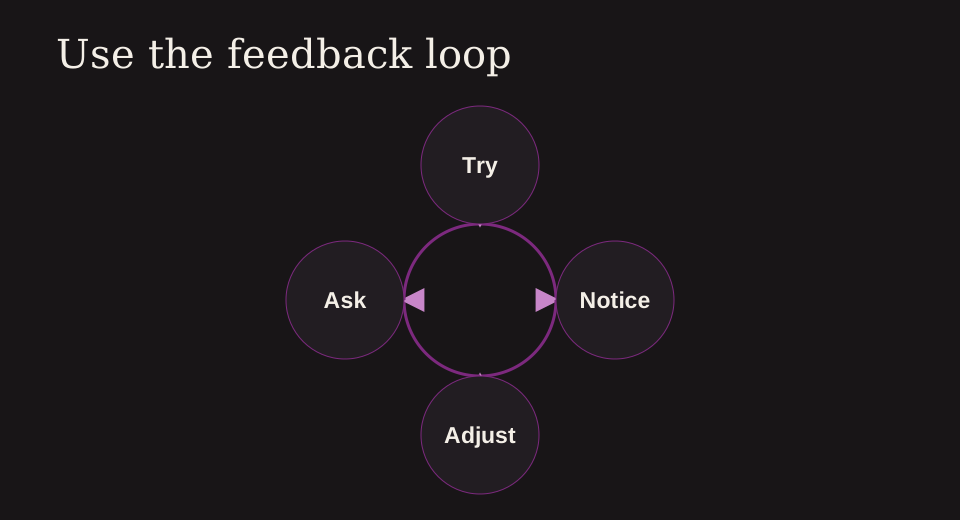
After the exercise, ask a few simple questions:
- What did you notice first?
- Which part was easiest to follow?
- Was there a moment that felt unclear?
- Did a particular image or phrase help?
Then listen without trying to defend the attempt or decide whether it was a success or failure.
Maybe the person understood the instructions but lost focus when you added too many details. Maybe one phrase made the experience more vivid. Maybe your explanation before the exercise was not clear enough yet.
That is not bad news. That is your next practice plan.
When I was learning, recording attempts and watching them back made this much easier. You start to notice which suggestions felt natural, which ones got a response, and which ones were just extra words. Then you remove what did not help and keep building on what did.
Do not overthink the “right” script
Scripts can be useful while you are getting comfortable. A short mini-script gives you something to practice until the basic flow feels natural.
But the goal is not to memorize every word somebody else uses. The goal is to understand what each part is trying to do.
When you understand the job of a suggestion, you can say it in a way that fits the person in front of you. That is why understanding hypnosis matters more than collecting scripts.
Keep one simple setup, one exercise, and one clear ending in your toolbox. Practice those until you do not have to fight to remember what comes next.
Practice within a simple, responsible scope
Early practice is for learning how to guide attention, communicate clearly, and observe responses. Keep the goal small and educational.
Do not turn an early practice session into an attempt to handle trauma, mental-health conditions, medical concerns, or a serious personal problem. If somebody needs that kind of support, encourage appropriate qualified care.
A good first session can be short, clear, willing, and respectful. You do not need to make it bigger than that.
What to do after your first attempt
Pick one thing you want to improve before the next attempt.
Maybe you will slow down your instructions. Maybe you will make the pre-talk clearer. Maybe you will ask a better question afterward. One adjustment is enough.
The point is not to become a different hypnotist after every practice session. The point is to become a little more observant, a little more comfortable, and a little more prepared each time you guide someone through the process.
Start small. Pay attention. Use the feedback. Then practice again.